
80/20 Rule

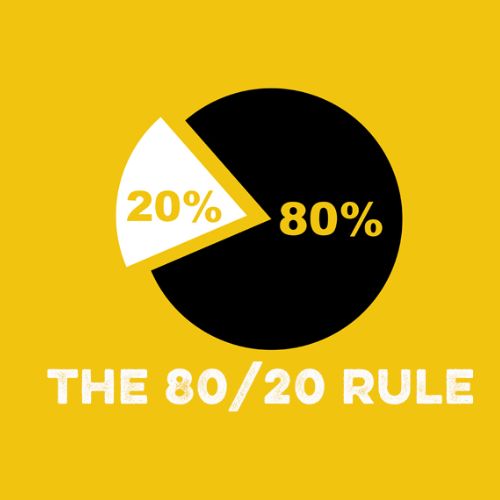
Most likely, many of you who are in business understand what they call the 80/20 rule. The 80/20 rule is where usually 80% of your business comes from 20% of your customers. Now, one particular day I really thought about this statistic. Do we really want to adhere to the 80/20 rule and get 80% of our business from 20% of our customers? If that applies, what does the other 80% of our customers look like?  

Here’s my theory on this. We all started a business from scratch. Day one, our goal, obviously, is to get business, get customers, bring them in, and start generating revenues. Then somewhere down the road, maybe one, two, three, four, five, ten years later, who knows, we start realizing that a large majority of our customers we really don’t like. They might not be ideal customers.  Now, in fact, I have a coaching practice. I love all my clients. However, I’m very clear on the type of client I want to work with. As when they are committed to doing the work, they get results, and we all win.  

I thought about the idea of what would happen if we all got crystal clear on exactly what an ideal customer or client looks like as soon as we start our business so we can market accordingly from the very beginning. If we were to apply this strategy, we would then attract the people we love doing business with, who come back, stay with us a long time, spend more money, and tell their colleagues and friends. They’re happy because you’re delivering your products and service with excellence and you’re happy because your business is growing.  

I learned something about 10 years ago from Michael Losier at a conference, and it’s called Contrast Clarity. If anybody wants the template, feel free to reach out. It’s just a Word document that on one side, says contrast where you write down all the things you don’t want in a customer, or a person on your team, or a marketing assistant. And the other side, it says clarity, where you write down everything you want in a customer, in your team, or an ideal marketing person. 

For me, my contrast side represents business owners who don’t do the work, who don’t stay long, or who are resistant. My clarity side represents clients that do the work, and more, clients that stay for 1, 2, 3, 5 years or more, and clients that are open to anything I share with them to take them and their organization to the next level. When you get clear on exactly what you don’t want and you get clear on what you do want, and you consistently articulate that, you’ll be crystal clear anytime you see the right person for your team, or that perfect potential customer or client. There’s nothing more powerful than telling somebody, “You would be a perfect client for me. And it’s okay if I tell you why.” They usually will agree because they are that person, because of the clarity that you created. 

I now challenge you; instead of abiding by the 80/20 rule that’s been around for who knows how long, get clear on exactly who you want as your customer, as your client, and as for the people for your team. Write down exactly what you don’t want. Write down exactly what you do want. Create that clarity that a hundred percent of your business will be coming from a hundred percent of your clients that you enjoy working with. Create that clarity that everyone on your team is an ideal to represent your organization. Do this and you will create a win/win for all involved. 

COACH MICHAEL DILL is an Award-Winning Certified Business Coach, global speaker, and published author. He is a proud Action Coach Franchise partner as well as the President of Power & Ice Wealth Creation a strategic leadership company that works with business owners, leaders, teams, and entrepreneurs to both develop a systematized and structured organization while accelerating their mindset, efficiencies, and effectiveness to grow both personally and professionally to achieve extraordinary results. He brings more than 40 years of business and entrepreneurial experience in his leadership, team training, and mentoring practice. Businesscoachmichaeldill.com


The Power of Asking Permission

Many times, we as leaders, as spouses, and as parents, we just start giving other people advice, telling them what they should do, and how they should do it differently. Consider this, most times when we just take it upon ourselves to dictate to others, is the other party really listening? Are they taking it … Read more

We’re Coming!

If you’re an executive, business owner, or a CEO that deals with a lot of different employees. I have a question for you. If you took your organization and took only 10 team members from a year ago and applied 86 new team members all at the same time, do you believe that in less … Read more

GREATNESS

What is greatness? Well, I’ve broke it down. Gratitude. To be great we first must be grateful for what we already have. When you’re grateful for what you have, you will witness more as well as you will always attract more. Resiliency. We need to be resilient. There’re plenty of obstacles that will come our … Read more

Inform, Inspect, Inspire!

If you’re a leader and you want to get better results with your team, I’m going to share with you a simple tip. Follow the three I’s. That’s it. The three I’s. Inform, Inspect, Inspire.   Information is vital. Inform your team in exactly what needs to be done. Make it very clear on their roles and … Read more

How to Make an IMPACT!

I’m sure if you’re like me, you’d like to make a difference for yourself, your family, your community, your business, your team, your customers, your clients. And to do that, we need to make an impact. I took a look at that word and broke it down, and this is what I believe impact means.  … Read more

It was EPIC!

I belong to a select group called the Red Meat Lovers Club https://rmlclub.com/ . It’s a group where we, once a month get together, raise money for charities, eat fantastic food, have a cocktail or two, and socialize. However, most importantly, there was an event we had several months ago on Saint Patrick’s Day weekend … Read more

Practice the Oyster Theory

I’d like to share what we call the Oyster Theory. Oysters are where pearls come from, those beautiful pearl necklaces that our ladies love to wear, gleaming in the sun and the light so others can admire them. However, how is that oyster formed? It’s formed from being in the comfortable protective environment of the oyster. That environment is stable so that the pearl has a chance to grow into its beauty. 

I used to work in the restaurant industry where they educated us on the Oyster Theory. If you’ve ever been to a restaurant, I’m sure you’ve experienced this, and what I’m about to share is the same in business, so be very conscious of what you are reading. You visit a restaurant, it’s clean, it’s actually spotless. You go to the restroom, it’s immaculate. The waiter or waitress comes to your table, they’re cheerful. They’re enthusiastic. They’re having fun. They actually create an event for you because they’re in such a great mood. They’re upselling you without you even knowing it because you’re just going along for the ride. The hot food comes out hot, the cold food comes out cold, and it all comes out in a timely manner. Have a great meal. You get great service. The place is clean, and the check comes in a timely manner. Everything is great. 

Because of this, that restaurant is doing well. The revenues and profits are increasing. They become extremely successful. They’re one of the best restaurants in the industry, in their town, in their community. Then they get a little complacent and unfortunately, adopt what we call the Success Syndrome. The restaurant isn’t as clean. The busboy or bus girl isn’t going frequently into the restrooms in making sure they’re immaculate. Paper towels are on the floor. The basket is over full. The waiters and waitresses are a little bit arrogant. They’re not as cheerful. They complain about their tips. The cold food doesn’t come out as cold. The hot food doesn’t come out as hot, and it’s no longer coming out in a timely manner. 

The whole ambiance of the restaurant has changed. A few months go by. The regional managers and the district managers are sitting around brainstorming as they can’t figure out why revenues and profits have dipped. The number of people visiting the restaurant has shrunk. They can’t figure it out. They got complacent. They unconsciously adopted The Success Syndrome as opposed to continuing practicing the Oyster Theory. 

I share this because in business we can possibly and unconsciously adopt the same pattern. As you’re doing everything right in your organization, you’ve created the right culture. You conduct your team meetings on a consistent schedule. You’re following up on KPIs, key performance indicators with your team, making sure they’re sticking to what they’re supposed to do in a timely manner. Your team exhibits great attitudes. You’re keeping your marketing flowing to keep your brand visible. Your service mastery is excellent because you’re taking care of your customers consistently. You’re doing everything right in your business. 

Don’t get complacent. Trust me, if you do, everything you’ve worked on will begin to slowly erode to the point you won’t even notice it until months, maybe years down the road when you’re trying to figure out what happened to that momentum you once had. 

The theory is, when you do everything right, what you did yesterday doesn’t matter. What you do today most definitely matters. Just because you showed up with excellence yesterday doesn’t mean you can relax today. You need to show up with excellence every day. Make sure you are adhering to the Oyster Theory. Your business, your clients, your team, your organization, that’s the pearl that you’re cultivating. Make sure that environment is right so that the pearl can come out nice and shiny so everyone can admire it, just like they’re going to admire your organization doing what’s right and delivering the goods and services to your customers and clients with excellence each and every day. 

COACH MICHAEL DILL is an Award-Winning Certified Business Coach, global speaker, and published author. He is a proud Action Coach Franchise partner as well as the President of Power & Ice Wealth Creation a strategic leadership company that works with business owners, leaders, teams, and entrepreneurs to both develop a systematized and structured organization while accelerating their mindset, efficiencies, and effectiveness to grow both personally and professionally to achieve extraordinary results. He brings more than 40 years of business and entrepreneurial experience in his leadership, team training, and mentoring practice. Businesscoachmichaeldill.com

How Can You Control Your Outcome?

Today we’re going to go over a simple equation that comes from Jack Canfields’ book “The Success Principles”. Three little letters. E+R=O. And what does that mean? Event plus reaction equals outcome. Let’s take a scenario. Let’s take an event that you have no control over. Let’s just say it’s the economy’s not doing well. You as a business owner are concerned. Your energy is showing up a little tight in the organization. You’re pulling back the marketing dollars for your organization and because of that, your brand isn’t out there as much as prior. Your team’s getting tight as you laid some people off. They’re wondering if they’re next to go. Your reaction to the event is creating an outcome of nervousness, lack of productivity, and tightness in your team. It may affect your revenues. It may affect your margins.  

Let’s take that same scenario. The economy’s not doing well, however, as a leader of an organization, you see an opportunity. You see how your competitors are pulling back because they’re nervous. You’re going to use this event to your advantage. You increase your marketing dollars to get your brand out there even more. You praise your people for being a great team. You let them know that none of you are going anywhere. We’re going to use this as an opportunity to increase our sales and get more of the market share. Your energy is positive. Your team picks up on that energy. They’re more productive. Revenues are maintained or increased. The bottom line is good. Same event, different reaction, different outcome. 

Let’s say an event happened that you can control. One of the employees on your team didn’t show up the way they were supposed to show up and deliver the way they should deliver. You react indifferently as a leader, negatively in front of everybody on the team. You belittle that person. Your frustration comes out. That person may or may not step up in the future. They’re definitely not going to take any chances to offend you. Other people on the team might not speak up or ask for advice or give their opinion because they’re fearful of you. Your reaction was indifferent. Your outcome could be a lack of productivity or lack of trust. It could erode the alignment of your team, which could affect revenues and profits. 

The same event, somebody didn’t show up as they should have. They didn’t deliver the results in a timely manner. You as a leader ask if you could get a little bit of their time. You take them into the office, you sit them down. You talk about the fact of how long they’ve been here at the organization. You tell them all the things you’ve noticed that they do and excel at. What value they bring to the team. And then you ask for their permission if you can share some recent observations. And you share that recently, it doesn’t seem like you’re showing up like you usually do. Is everything okay? And you have a conversation around that. You let them know you expect more from them. This is not like you. You coach them up. You praise them on what they do well, and then you talk about what they need to do to get a little bit better. You thank them once again for what they do with your organization. You ask for the commitment to get better, and you send them on their way.  

Your reaction is different. It’s a reaction of a leader. It’s a conversation with your team. You’re pumping them up. You’re letting them know where they stand. They feel better about themselves. They commit to stepping up even more. The other team members see you as a leader of an organization they want to follow. A likely outcome could be increased productivity, and increased alignment of the organization, which most likely deliver additional revenues and profits. Same event, different reaction, entirely different outcome. 

In conclusion; realize sometimes you can’t control the E, the event. You certainly can control the R, which is your reaction. And when you control your reaction in the right way, that will deliver the outcome you’re looking for.  

COACH MICHAEL DILL is an Award-Winning Certified Business Coach, global speaker, and published author. He is a proud Action Coach Franchise partner as well as the President of Power & Ice Wealth Creation a strategic leadership company that works with business owners, leaders, teams, and entrepreneurs to both develop a systematized and structured organization while accelerating their mindset, efficiencies, and effectiveness to grow both personally and professionally to achieve extraordinary results. He brings more than 40 years of business and entrepreneurial experience in his leadership, team training, and mentoring practice. Businesscoachmichaeldill.com